A pretty similar web 2.0 mashup as like swiss-aviation-master-thesis can bee seen here on flightradar24.com. Live air travel informations. A mashup with google maps.
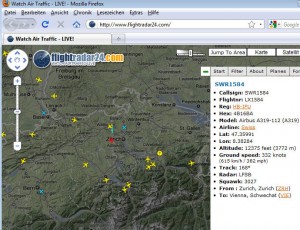
Select your region, then the currently flying planes appear. Just click on plane or airport and see more details like this sample:
Air Travel code: SWR1584 🔗
- Callsign: SWR1584
- Flightnr: LX1584
- Reg: HB-IPU
- Hex: 4B16BA
- Model: Airbus A319-112 (A319)
- Airline: Swiss
- Lat: 46.99118
- Lon: 9.06084
- Altitude: 24675 feet (7521 m)
- Ground speed: 458 knots (848 km/h / 527 mph)
- Track: 127°
- Radar: NET2
- Squawk: 3027
- From : Zurich, Zurich (ZRH)
- To: Vienna, Schwechat (VIE)
Update on Air Traffic Mashup Flightradar for the years 2021 to 2024 🔗
The Air Traffic Mashup Flightradar was a popular tool back in 2011 for tracking real-time air travel information. Users could select their region and see the planes currently flying in that area, along with details about each flight by clicking on the plane or airport of interest. The mashup integrated data from sources like Google Maps, radar information, and flight details.
As of 2024, the concept of real-time air traffic tracking has evolved significantly. While Flightradar still exists and provides valuable information, there are now even more advanced tools available to the public. One major development in recent years is the widespread use of Automatic Dependent Surveillance – Broadcast (ADS-B) technology. This technology allows aircraft to broadcast their positions and other data, which can be picked up by ground stations and satellite receivers.
Platforms like Flightradar have incorporated ADS-B data into their systems, offering users a more comprehensive and accurate view of air traffic around the world. This means that in 2024, users can track a larger number of flights, with more detailed information on each aircraft’s position, altitude, speed, and flight path.
Furthermore, the integration of artificial intelligence (AI) and machine learning algorithms has improved the predictive capabilities of air traffic tracking tools. Users can now receive alerts on flight delays, diversions, or cancellations based on historical data and real-time conditions. This helps passengers better plan their travel and stay informed about any changes in their flight schedules.
In addition, the COVID-19 pandemic had a significant impact on air travel, leading to disruptions in flight schedules and changes in air traffic patterns. Tools like Flightradar have adapted to these changes by providing up-to-date information on travel restrictions, airport closures, and health and safety measures implemented by airlines.
Overall, the Air Traffic Mashup Flightradar has transformed over the years to provide a more sophisticated and user-friendly experience for tracking air travel. With advances in technology and data integration, users in 2024 can access a wealth of information about flights around the world, making it easier to stay informed and plan their journeys effectively.
Air Traffic Monitoring with Flightradar24: A Comprehensive Guide 🔗
Are you fascinated by air travel and want to track flights in real-time? Flightradar24 is the perfect tool for you. With this comprehensive guide, you will learn how to use Flightradar24 to see live air traffic information and track flights around the world.
Getting Started with Flightradar24 🔗
Flightradar24 is a web 2.0 mashup that integrates data from sources like Google Maps, radar information, and flight details to provide users with real-time air traffic information. To start using Flightradar24, simply go to the website and select your region of interest. You will then see the currently flying planes in that area.
Tracking Flights with Flightradar24 🔗
Once you have selected your region, you can click on any plane or airport to see more details about the flight. This includes information such as the flight code, callsign, airline, altitude, ground speed, and flight path. You can also see details about the departure and arrival airports, as well as the aircraft model.
Using Advanced Features 🔗
Flightradar24 has evolved over the years to incorporate advanced technologies like Automatic Dependent Surveillance-Broadcast (ADSB). This technology allows aircraft to broadcast their positions, providing users with a more accurate view of air traffic. With ADSB data, you can track a larger number of flights and receive detailed information on each aircraft.
The Future of Air Traffic Monitoring 🔗
As of 2024, Flightradar24 has continued to innovate and improve its services. The integration of artificial intelligence and machine learning algorithms has enhanced the predictive capabilities of the tool, allowing users to receive alerts on flight delays and cancellations. Additionally, Flightradar24 has adapted to the impact of the COVID-19 pandemic by providing up-to-date information on travel restrictions and safety measures.
Fazit 2025: The Evolution of Air Traffic Monitoring 🔗
In 2025, Flightradar24 has become an indispensable tool for tracking air travel. With advancements in technology and data integration, users can access a wealth of information about flights around the world. The integration of ADSB technology and AI algorithms has transformed the user experience, making it easier to stay informed and plan journeys effectively. Flightradar24 continues to set the standard for real-time air traffic monitoring, providing users with a comprehensive and reliable tool for tracking flights.
Whether you are a frequent flyer, aviation enthusiast, or simply curious about air travel, Flightradar24 is the ultimate resource for real-time air traffic monitoring. Start using Flightradar24 today and experience the thrill of tracking flights around the world.