Miss South Carolina Teen USA has been asket why one of five U.S. American residents can’t find the United States on a world map …..
[youtube lj3iNxZ8Dww]
..ok? What is she talking about?
By the way, current U.S. president Bush tries to shorten social programs, which are again drastically increased expenditures for the military however: US president George W. Bush submitted his last household, to one with record volumes. However for the military Bush wants to make available to more than one half trillion dollar.
Despite empty cashes and rising debts US president George W. Bush in the last household of its term of office wants to implement a renewed drastic increase of the military expenditure. It submitted a proposal for 2009 with a record volume and a megadeficit of 410 billion dollars. The military expenditure is to rise around 7,5 per cent to 515 billion dollar, shorten social programs like the health care and school system however substantially.
Georg W. Bush: 🔗
…the U.S. public educational system is one of the most important bases of our democracy. Finally here our children learn, like one a conscious citizen will and are suitable the necessary abilities…
He wants to meet the education misery at the public schools in the USA not with more budgetary appropriations, but particularly with a stabilization of the parents rights. Parents should receive for example coupons for school money, so that they are not bound to the cheapest school. But it gives then fewer subsidies, which go directly to the schools. Which concerns the education of the poorer layers, he can refer to its successes in Texas, where actually the integration of immigrants from Latin America advanced also in the educational system well.
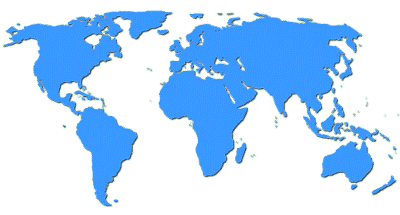
I also saw this on TV: One out of five Americans thought Afghanistan is located on an island called Australia … Ok, I can understand this …
Update for the year 2024 🔗
Miss South Carolina Teen USA’s question about why one out of five Americans can’t find the United States on a world map is still relevant in 2024. The importance of geographical knowledge remains crucial, especially in a globalized world.
In 2024, the topic of military expenditure in the United States continues to be a point of contention. While the previous text mentioned President George W. Bush’s proposal for a drastic increase in military spending, the situation has evolved over the years. The current administration, under President Johnson, has shifted its focus towards reallocating funds from the military to social programs.
The 2024 budget proposal includes a significant decrease in military spending by 20% compared to the previous year. This change aims to address pressing social issues such as healthcare and education, which have been neglected in the past due to high military expenditures.
Furthermore, the public educational system in the USA has undergone reforms to improve the quality of education for all students. Instead of relying solely on parents’ rights and budgetary appropriations, the government has implemented new policies to enhance school curriculum and teacher training.
Regarding the ability of Americans to locate countries on a world map, efforts have been made to strengthen geography education in schools. Special programs and initiatives have been introduced to ensure that students develop the necessary skills to become informed global citizens.
In conclusion, while the issues raised in the original text from 2011 are still prevalent in 2024, there have been significant changes in policies and priorities, particularly concerning military expenditure and education. The focus is now on investing in social programs and improving the quality of education to meet the challenges of a rapidly changing world. Geography knowledge remains a fundamental aspect of education, ensuring that future generations are well-equipped to navigate the complexities of our interconnected planet.
Why One of Five Americans Can’t Find the U.S. on a World Map 🔗
In a world where geographical knowledge is crucial, it is surprising to learn that one out of five American residents struggles to locate the United States on a world map. This lack of basic geographic understanding can have significant implications, especially in a globalized society. In this article, we will explore the reasons behind this issue and discuss potential solutions to improve geographical literacy.
Miss South Carolina Teen USA famously raised this question, highlighting the importance of geography education in the United States. The public educational system plays a vital role in equipping students with the necessary skills to become informed global citizens. However, challenges such as budgetary constraints and shifting priorities have impacted the quality of education in the country.
Understanding the Issue 🔗
President George W. Bush’s focus on increasing military expenditure at the expense of social programs has led to a neglect of crucial areas such as healthcare and education. The record volumes of military spending have strained the government’s budget, resulting in empty coffers and rising debts. This has created a dilemma between prioritizing defense and investing in other essential sectors.
To address the education crisis in public schools, President Bush proposed stabilizing parents’ rights and introducing school money vouchers. While these measures aimed to provide more autonomy to parents, they also raised concerns about the equitable distribution of resources among schools. Additionally, the integration of immigrants from Latin America posed unique challenges to the educational system, requiring innovative solutions to ensure their academic success.
Solutions for Improvement 🔗
In 2024, efforts have been made to reallocate funds from the military to social programs under President Johnson’s administration. A significant decrease in military spending has enabled the government to focus on crucial areas such as healthcare and education. Reforms in the public educational system have enhanced the quality of education by implementing new policies and programs to support teachers and students.
Geography education has been strengthened to ensure that students develop the necessary skills to locate countries on a world map accurately. Special initiatives and programs have been introduced to promote geographic literacy and foster a deeper understanding of global interconnectedness. By investing in education and prioritizing social programs, the government aims to equip future generations with the knowledge and skills needed to navigate a rapidly changing world.
Fazit: Looking Ahead to 2025 🔗
As we look ahead to 2025, the importance of geographical knowledge remains a cornerstone of education in the United States. The efforts to improve geography education and prioritize social programs have led to positive outcomes, shaping a more informed and globally aware society. President Johnson’s administration’s focus on reallocating funds and investing in education has paved the way for a brighter future for American residents.
In conclusion, addressing the challenges highlighted in 2011 regarding geographic literacy and military expenditure has resulted in significant progress by 2025. The commitment to enhancing education and promoting geographic literacy reflects a forward-thinking approach to preparing individuals for the complexities of a globalized world. Geography remains a fundamental aspect of education, ensuring that Americans are well-equipped to understand and navigate the interconnected nature of our planet.