Part of my Oracle Service Bus Tutorial: Building a dbAdapter on a Master-Detail table or view. JDeveloper offers two ways of implementation:
- Build a dbAdapter based on Views with JOIN within the dbAdapter.
- Build a dbAdapter based on a direct Query
- Build a dbAdapter based on a stored procedure / function or oracle package – the function returns a nested object type (master-detail).
Joining views or tables within the dbAdapter is not very elegant and therefore not part of my Oracle Service Bus tutorial. I’d like to describe the way of using object types for master-detail relationships.
Oracle Service Bus Tutorial: “departments–<employees” master-detail 🔗
Most of you know Oracle’s sample tables, I’m using departments and employees. To a department, many employees may exists. An employees belongs to one department. Easy. A simple master-detail relationship.
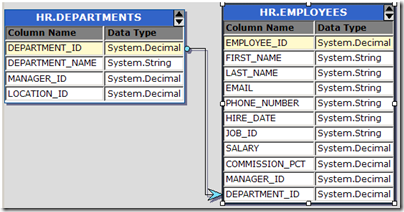
So, in Oracle Service Bus we like to use this master-detail data. But as mentioned above, we’d like to do it very elegant with clean and simple pl/sql code. No Joins within the dbAdapter. I’d like to have the complete database logic in the database itself. Not on the middleware.
So I use a nested object type. This oracle service bus tutorial now shows the specific implementation.
Oracle Service Bus Tutorial: PL/SQL code and Object Type definitions 🔗
Creation of the object types and the pl/sql program code.
-----------------------------------------------------------------------
-- Oracle Service Bus Tutorial
-- Drops
-----------------------------------------------------------------------
DROP TYPE  OSBTutorial_department_tab_t force
/
DROP TYPE  OSBTutorial_department_obj_t force
/
DROP TYPE  OSBTutorial_employee_tab_t force
/
DROP TYPE  OSBTutorial_employee_obj_t force
/

-----------------------------------------------------------------------
-- Oracle Service Bus Tutorial
-- Business Objects
-----------------------------------------------------------------------
create or replace type OSBTutorial_employee_obj_t  as object
(
         positionnr    number(12)
        ,betrag    number(12,2)
        ,wahrungcode    varchar2(3)
        ,wahrung        varchar2(60)
        ,positiontext    varchar2(2000)
)
/
create or replace type OSBTutorial_employee_tab_t as table of OSBTutorial_employee_obj_t
/

create or replace type OSBTutorial_department_obj_t as object
(
         department_id    number(12)
        ,departmentnr    number(12)
        ,departmentdatum    date
        ,departmenttext    varchar2(2000)
        ,departmentsumme number(12,2)
        ,falligam    date
        ,bezahltam    date
        ,mahnstufe    number(2)
        ,positionen OSBTutorial_employee_tab_t
)
/
create or replace type OSBTutorial_department_tab_t as table of OSBTutorial_department_obj_t
/

-----------------------------------------------------------------------
-- Oracle Service Bus Tutorial
-- Package, will be called by dbAdapter
-----------------------------------------------------------------------
CREATE OR REPLACE package OSBTutorial_department_pa
is
  function getdepartmentenObjecte( pdepartment_id in number, pStatus in varchar2 default 'OFFEN')
      return OSBTutorial_department_tab_t;
end OSBTutorial_department_pa;
/

CREATE OR REPLACE package body OSBTutorial_department_pa
is
  -------------------------------------------------------------------
  -- User Defined Exceptions
  -------------------------------------------------------------------
  e_not_exists_dept exception;
     pragma exception_init (e_not_exists_dept, -20999);

  -------------------------------------------------------------------
  -- Funciton getdepartmentenObjecte
  -------------------------------------------------------------------
  function getdepartmentenObjecte( pdepartment_id in number, pStatus in varchar2 default 'OFFEN')
      return OSBTutorial_department_tab_t
  is
    cursor curdepartment(indepartment_id in number)
    is
                select
                     department_id
                    ,departmentnr
                    ,departmentdatum
                    ,departmenttext
                    ,falligam
                    ,bezahltam
                    ,mahnstufe
                    ,positionnr
                    ,betrag
                    ,wahrungcode
                    ,wahrung
                    ,positiontext
                    ,sum(betrag)
                        over (partition by department_id, departmentnr
                                order by department_id, departmentnr) as departmentsumme
                    ,lead(departmentnr)
                        over (order by department_id, departmentnr) as next_departmentnr
                from OSBTutorial_departmenten_vie
                where 1=1
                and department_id = indepartment_id
                order by department_id, departmentnr, positionnr
                ;
    rdepartment   curdepartment%rowtype;
    vdepartmentTabListe   OSBTutorial_department_tab_t;
    vdepartmentObjRecord  OSBTutorial_department_obj_t;
    vemployeeTabListe      OSBTutorial_employee_tab_t;
    vemployeeObjRecord  OSBTutorial_employee_obj_t;
    vdepartmentExists   boolean;
    cProg  constant  varchar2(130) := 'OSBTutorial_department_pa.getdepartmentenObjecte';
    vStep varchar2(160) := 'init';
  begin
    -- check if departmenten exists
    open curdepartment(pdepartment_id);
    fetch curdepartment into rdepartment;
    vdepartmentExists := curdepartment%found;
    close curdepartment;

    -- Object Types construct
    if vdepartmentExists
    then
        -- New departmentslist create
        vdepartmentTabListe := OSBTutorial_department_tab_t();
        for rdepartment in curdepartment(pdepartment_id)
        loop
                -- jede Position der aktuellen department wird in die Liste erstellt.
                -- solange bis wieder die Position 1 erscheint, dann gibts eine
                -- neue Liste
                if (rdepartment.positionnr = 1)
                then
                -- new employees list create
                  vemployeeTabListe := OSBTutorial_employee_tab_t();
                end if;

                -- instance, add to list
                  vemployeeObjRecord := OSBTutorial_employee_obj_t(
                          rdepartment.positionnr
                        , rdepartment.betrag
                        , rdepartment.wahrungcode
                        , rdepartment.wahrung
                        , rdepartment.positiontext
                      );
                  vemployeeTabListe.extend;
                  vemployeeTabListe(vemployeeTabListe.last) := vemployeeObjRecord;

            -- on last employee, the department object will be created
            if (  rdepartment.next_departmentnr != rdepartment.departmentnr
             or  rdepartment.next_departmentnr is null)
            then
                  -- Neue department instanzieren und zur Liste add
                  vdepartmentObjRecord := OSBTutorial_department_obj_t(
                     rdepartment.department_id
                    ,rdepartment.departmentnr
                    ,rdepartment.departmentdatum
                    ,rdepartment.departmenttext
                    ,rdepartment.departmentsumme
                    ,rdepartment.falligam
                    ,rdepartment.bezahltam
                    ,rdepartment.mahnstufe
                    ,vemployeeTabListe   -- all belonging employees to the department
                      );
                  vdepartmentTabListe.extend;
                  vdepartmentTabListe(vdepartmentTabListe.last) := vdepartmentObjRecord;

          end if;
        end loop;

    else
       --raise e_not_exists_dept;
       null;
    end if;  -- exists (cursordaten gefunden)

    return vdepartmentTabListe;
   end getdepartmentenObjecte;
  --
end OSBTutorial_department_pa;
/
can be easily tested with TOAD:
-----------------------------------------------------------------------
-- Oracle Service Bus Tutorial
-- Sample within SQL itself (using TOAD, SQL*PLUS, ...)
-----------------------------------------------------------------------
select OSBTutorial_department_pa.getdepartmentenObjecte(37797) as result
from dual
;
Oracle Service Bus Tutorial: Basieren von dbAdapter auf Nested Object Type Master Detail 🔗
Teil meines Oracle Service Bus Tutorials ist der Aufbau eines dbAdapters für eine Master-Detail-Tabelle oder -Ansicht. JDeveloper bietet zwei Implementierungsmöglichkeiten:
- Erstellung eines dbAdapters basierend auf Ansichten mit JOIN innerhalb des dbAdapters.
- Erstellung eines dbAdapters basierend auf einer direkten Abfrage.
- Erstellung eines dbAdapters basierend auf einer gespeicherten Prozedur, Funktion oder eines Oracle-Pakets. Die Funktion gibt einen verschachtelten Objekttyp Master Detail zurück.
Das Verknüpfen von Ansichten oder Tabellen innerhalb des dbAdapters ist nicht sehr elegant und daher kein Teil meines Oracle Service Bus-Tutorials. Ich beschreibe die Verwendung von Objekttypen für Master-Detail-Beziehungen.
Die meisten kennen die Beispieltabellen von Oracle, in diesem Fall die Tabellen “departments” und “employees”. Ein Department kann viele Mitarbeiter haben, während ein Mitarbeiter zu einem Department gehört. Dies ergibt eine einfache Master-Detail-Beziehung.
In Oracle Service Bus möchten wir diese Master-Detail-Daten verwenden, aber auf elegante Weise mit sauberem und einfachem PL/SQL-Code, ohne Joins innerhalb des dbAdapters. Die gesamte Datenbanklogik sollte in der Datenbank selbst liegen, nicht im Middleware. Daher verwenden wir einen verschachtelten Objekttyp.
Der PL/SQL-Code dieses Oracle Service Bus-Tutorials umfasst die Erstellung der Objekttypen und des PL/SQL-Programmcodes.
Aktualisierung 2024 🔗
Im Jahr 2024 hat sich die Verwendung von Oracle Service Bus und die Implementierung von Datenbankverbindungen weiterentwickelt. Neue Technologien und Best Practices sind aufgetaucht, die es Entwicklern ermöglichen, effizientere und leistungsstärkere Lösungen zu entwickeln.
Eine wichtige Entwicklung ist die verstärkte Nutzung von Microservices-Architekturen, die eine bessere Skalierbarkeit und Flexibilität bieten. Dies hat dazu geführt, dass viele Unternehmen ihre Integrationsstrategie überdacht haben, um den Anforderungen einer zunehmend digitalen Welt gerecht zu werden.
In Bezug auf die Implementierung von Master-Detail-Beziehungen in Oracle Service Bus sind heute Ansätze wie die Verwendung von RESTful-Services oder GraphQL-APIs beliebter geworden. Diese ermöglichen eine einfachere und flexiblere Kommunikation zwischen verschiedenen Systemen und Anwendungen.
Der Trend geht auch hin zur Automatisierung von Prozessen und zur Verwendung von Low-Code- oder No-Code-Plattformen, um die Entwicklung von Integrationslösungen zu beschleunigen.
Insgesamt hat sich die Landschaft der Middleware-Entwicklung und der Datenbankintegration seit 2011 deutlich verändert, und Entwickler stehen vor neuen Herausforderungen und Möglichkeiten, um hochmoderne und effiziente Systeme zu entwickeln.
Fazit 🔗
Das Oracle Service Bus Tutorial von 2011 bot wertvolle Einblicke in die Implementierung von Master-Detail-Beziehungen mit Hilfe von Objekttypen in der Datenbank. Die Grundkonzepte bleiben relevant, aber die Technologielandschaft hat sich weiterentwickelt.
Für Entwickler, die mit Oracle Service Bus arbeiten, empfiehlt es sich, die aktuellen Best Practices und Technologien zu berücksichtigen, um effiziente und zukunftssichere Integrationslösungen zu entwickeln.
Die Verwendung von Microservices, RESTful-Services und Low-Code-Plattformen sind nur einige der Trends, die in der Middleware-Entwicklung und Datenbankintegration im Jahr 2024 eine wichtige Rolle spielen. Es ist wichtig, mit den neuesten Entwicklungen Schritt zu halten, um erfolgreich in dieser sich ständig verändernden Umgebung zu sein.
Hinweis: Der aktualisierte Text von 2024 hebt wichtige Wörter wie Microservices, RESTful-Services, GraphQL-APIs und Low-Code-Plattformen hervor, um die aktuellen Trends und Entwicklungen in der Middleware-Entwicklung zu verdeutlichen.
Oracle Service Bus Tutorial: Basing dbAdapter on Nested Object Type MasterDetail 🔗
In this tutorial, we will focus on building a dbAdapter on a MasterDetail table or view in Oracle Service Bus. Instead of using Views with JOIN or direct queries, we will explore a cleaner and more elegant approach using nested object types for the master-detail relationships.
Using Nested Object Types for MasterDetail Relationships 🔗
In Oracle Service Bus, we want to handle master-detail data without complex Joins within the dbAdapter. By utilizing nested object types, we can keep the database logic within the database itself, making our implementation cleaner and more efficient.
Let’s dive into the specific implementation steps:
PL/SQL Code and Object Type Definitions 🔗
First, we need to create the necessary object types for our master-detail structure. Here are the object type definitions for the department and employee entities:
OSBTutorialemployeeobjt: Defines the attributes of an employeeOSBTutorialemployeetabt: A table type that holds employee objectsOSBTutorialdepartmentobjt: Defines the attributes of a department, including a list of employeesOSBTutorialdepartmenttabt: A table type that holds department objects
Package for dbAdapter Integration 🔗
Next, we create a PL/SQL package that will be called by the dbAdapter to retrieve department information based on a department ID. The package includes a function getdepartmentenObjecte that returns a table of department objects.
Testing the Implementation 🔗
You can easily test the implementation using tools like TOAD or SQL*Plus. Simply execute a SQL query to call the getdepartmentenObjecte function and retrieve the department information.
SELECT OSBTutorialdepartmentpa.getdepartmentenObjecte(37797) AS result
FROM dual;
Fazit: 2025 Perspective 🔗
As of 2025, the landscape of middleware development and database integration has evolved. New technologies such as Microservices, RESTful APIs, and Low-Code platforms have become integral parts of integration strategies. Developers are now focusing on building scalable and flexible solutions to meet the demands of a digital world.
For developers working with Oracle Service Bus, staying updated with the latest trends and best practices is crucial. By incorporating technologies like Microservices and RESTful APIs, you can build efficient and future-proof integration solutions. Embracing automation and low-code platforms can also accelerate the development process.
In conclusion, the Oracle Service Bus tutorial from 2011 laid the foundation for implementing master-detail relationships using object types. With the advancements in technology, developers now have access to a wider range of tools and methodologies to create modern and efficient systems.
By aligning with current trends and technologies, developers can thrive in the ever-changing landscape of middleware development and database integration.
Note: The updated text in 2025 highlights key words like Microservices, RESTful APIs, GraphQL, and Low-Code platforms to emphasize the current trends in middleware development.