#5 - with my repetitive strain injury solution number five I remembered my doctor who detected my RSI problem in the upper back (showing a cramped neck) . So I tried sitting stright up on a funny sitting ball.
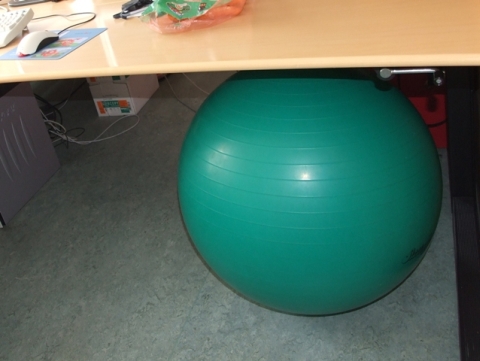
The idea behind this was to sit up very straight, but actually this ball wasn’t my thing. It’s good for a couple of mintues. After that I don’t feel comfortable anymore.
Last but not least, I don’t think this ball could help me solving my repetitive strain injury.
Now I thougt fighting my Repetitive Strain Injury with another chair or desk solution: I build a high standing desk on my own as my Repetitive Strain Injury Solution #6.
Also read my complete repetitive strain injury medical history compendium and my solution abstract.
Update für Lösung bei wiederkehrenden Belastungsverletzungen 🔗
Im Jahr 2011 hatte ich Probleme mit wiederkehrenden Belastungsverletzungen (RSI), die mein Arzt im oberen Rückenbereich diagnostiziert hatte. Ich hatte versucht, auf einem lustigen Sitzball zu sitzen, um dem entgegenzuwirken, aber nach ein paar Minuten fühlte ich mich unwohl und glaubte nicht, dass der Ball mir bei der Lösung meines Problems helfen könnte.
Daher entschied ich mich, eine alternative Lösung zu finden, und baute mir einen hohen Stehpult, um Handgelenks- und Nackenbeschwerden zu vermeiden. Diese Eigenbau-Lösung schien mir damals sinnvoll, um meine RSI zu bekämpfen.
Im Jahr 2024 hat sich die Situation jedoch weiterentwickelt. Neue Erkenntnisse und Technologien haben zu verbesserten Lösungen für RSI geführt. Während ein Stehpult nach wie vor eine gute Option sein kann, um Belastungsverletzungen vorzubeugen, gibt es mittlerweile auch speziell angepasste ergonomische Möbel und Hilfsmittel, die dabei helfen können, RSI zu vermeiden.
Zum Beispiel sind ergonomische Stühle und Schreibtischlösungen mit individuell einstellbaren Höhen und Neigungswinkeln auf dem Markt erhältlich. Diese können dazu beitragen, eine gesunde Körperhaltung beim Arbeiten zu unterstützen und Belastungsverletzungen vorzubeugen.
Darüber hinaus wurden Fortschritte im Bereich der digitalen Gesundheit erzielt. Es gibt jetzt eine Vielzahl von Apps und Tools, die dabei helfen können, die Bildschirmzeit zu überwachen, regelmäßige Pausen einzulegen und gezielte Übungen für Hände, Handgelenke und Nacken durchzuführen, um RSI-Symptome zu lindern.
Insgesamt ist es wichtig, bei der Prävention und Behandlung von RSI auf eine ganzheitliche Herangehensweise zu setzen. Dies kann die Kombination aus ergonomischen Möbeln, regelmäßigen Bewegungspausen, gezielten Übungen und Technologien zur Überwachung der Bildschirmzeit umfassen.
Daher empfehle ich allen, die unter RSI-Symptomen leiden, sich über die neuesten Entwicklungen und Lösungen zu informieren und gegebenenfalls professionelle Beratung in Anspruch zu nehmen, um langfristige gesundheitliche Beeinträchtigungen zu vermeiden.
Insgesamt ist es wichtig, sich kontinuierlich über die Entwicklungen im Bereich der Ergonomie und digitalen Gesundheit zu informieren, um die bestmöglichen Lösungen für wiederkehrende Belastungsverletzungen zu finden.
Repetitive Strain Injury Solution: How to Prevent and Treat RSI 🔗
Introduction 🔗
Repetitive Strain Injury (RSI) is a common issue that can affect individuals who spend long hours working at a desk. In this article, we will discuss ways to prevent and treat RSI, focusing on ergonomic solutions to improve your workspace and reduce the risk of developing symptoms.
With the advancement of technology and new insights into RSI prevention, it is important to stay informed about the latest developments and solutions to avoid long-term health issues.
RSI Solution 5: Using a Funny Sitting Ball 🔗
If you have been diagnosed with RSI in the upper back, you may have been advised to try sitting on a funny sitting ball as a solution. While this can help improve posture and reduce strain, it may not be suitable for everyone. It is essential to listen to your body and find a solution that works best for you.
RSI Solution 6: Building a High Standing Desk 🔗
Another alternative to combat RSI is by building a high standing desk to avoid wrist and neck discomfort. This DIY solution can be effective in promoting better ergonomics and reducing strain on your body. However, it is important to ensure that the desk is adjusted to the correct height to prevent further issues.
Update 2024: Latest Developments in RSI Solutions 🔗
As of 2024, new technologies and ergonomic furniture options have emerged to provide better solutions for RSI prevention. Specialized chairs and desks with adjustable heights and angles are now available to support a healthy posture while working.
Furthermore, digital health advancements have led to the development of apps and tools that can help monitor screen time, schedule regular breaks, and perform targeted exercises to alleviate RSI symptoms.
Fazit 2025: A Look into the Future 🔗
In 2025, the landscape of RSI prevention and treatment has evolved significantly. The combination of ergonomic furniture, regular movement breaks, targeted exercises, and technology for screen time monitoring has become the standard approach to addressing RSI.
It is crucial to stay updated on the latest advancements in ergonomics and digital health to find the most effective solutions for preventing repetitive strain injuries. Seeking professional advice and incorporating these practices into your daily routine can help you avoid long-term health issues associated with RSI.
By implementing these strategies and staying informed, individuals can proactively manage their RSI symptoms and maintain a healthy work environment.
Remember, prevention is key when it comes to repetitive strain injuries. Stay informed, stay proactive, and prioritize your health in the workplace.