In a Oracle Service Bus (OSB) environment, a proxy service usually does some XML transformations. So a XML element conversion from business service data to endpoint WSDL structure will be done. In some cases, returning empty elements ( as ) is not allowed. This can only be handled programmatically. All the optional elements have to be checked against null value (NVL in SQL).
Pseudocode: If Element Value is Null, then do not return the complete Element
With XQuery it would look something like this:
(:: if element content is empty, then do not return the element ::)
{
if (data($detailViewCollection1/ns1:detailView[1]/ns1:email1) > "") then
(
{ data($detailViewCollection1/ns1:detailView[1]/ns1:email1) }
)
else()
}
(:: if element content is empty, then do not return the element ::)
{
if (data($detailViewCollection1/ns1:detailView[1]/ns1:email2) > "") then
(
{ data($detailViewCollection1/ns1:detailView[1]/ns1:email2) }
)
else()
}
(:: if element content is empty, then do not return the element ::)
{
if (data($detailViewCollection1/ns1:detailView[1]/ns1:telefon1) > "") then
(
{ data($detailViewCollection1/ns1:detailView[1]/ns1:telefon1) }
)
else()
}
Uuupps, very ugly, isn’t it? No programmer likes to program like this…..
Actually, in XQuery normal user defined functions can be created as like in most other languages:
declare function local:emptyValue($element as element() )
{
if (data($element) > "")
then
(
$element
)
else()
};
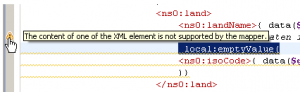
With this little function the main XQuery code looks much better. Unfortunatelly, the Oracle Service Bus (OSB) Editor in Eclipse OEPE doesn’t like this very much. The graphical tool shows a warning on each function call … “the content of one of the XML element is not supported by the mapper” ….
OK, let’s just ignore this graphical mapper problem, because we only initially use this mapper, after that all XQuery will be changed/edited in the source code itself.
So now it’s a little more clean XQuery code:
{local:emptyValue(
{ data($detailViewCollection1/ns1:detailView[1]/ns1:email1) }
)}
{local:emptyValue(
{ data($detailViewCollection1/ns1:detailView[1]/ns1:email2) }
)}
{local:emptyValue(
{ data($detailViewCollection1/ns1:detailView[1]/ns1:telefon1) }
)}
Update zu Oracle Service Bus XQuery Transformationen 🔗
In einer Oracle Service Bus (OSB)-Umgebung führt ein Proxydienst in der Regel einige XML-Transformationen durch. Eine XML-Elementkonvertierung von den Daten des Geschäftsdienstes zur Endpunkt-WSDL-Struktur wird vorgenommen. In einigen Fällen ist es nicht erlaubt, leere Elemente zurückzugeben. Dies kann nur programmgesteuert gehandhabt werden. Alle optionalen Elemente müssen auf Nullwert (NVL) überprüft werden.
Mit XQuery könnte es wie folgt aussehen: Wenn der Elementinhalt leer ist, sollte das Element nicht zurückgegeben werden.
if element content is empty then do not return the element
if data detailViewCollection ns detailView ns email then data detailViewCollection ns detailView ns email
else if element content is empty then do not return the element
if data detailViewCollection ns detailView ns email then data detailViewCollection ns detailView ns email
else if element content is empty then do not return the element
if data detailViewCollection ns detailView ns telefon then data detailViewCollection ns detailView ns telefon
Oh, das sieht sehr unansehnlich aus, oder? Kein Programmierer programmiert gerne auf diese Weise. Tatsächlich können in XQuery normale benutzerdefinierte Funktionen erstellt werden, wie in den meisten anderen Sprachen auch.
declare function local:emptyValue($element as element) as element {
  if data element then element else ()
}
Mit dieser kleinen Funktion sieht der Haupt-XQuery-Code viel besser aus. Leider mag der Oracle Service Bus OSB Editor in Eclipse OEPE das nicht besonders. Das grafische Tool zeigt eine Warnung bei jedem Funktionsaufruf an, da der Inhalt eines der XML-Elemente vom Mapper nicht unterstützt wird.
Nun ja, lassen Sie uns dieses Problem mit dem grafischen Mapper einfach ignorieren, denn wir verwenden den Mapper nur zu Beginn. Danach werden alle XQuery-Transformationen im Quellcode selbst geändert. Jetzt ist der XQuery-Code etwas sauberer:
local:emptyValue(data detailViewCollection ns detailView ns email)
local:emptyValue(data detailViewCollection ns detailView ns email)
local:emptyValue(data detailViewCollection ns detailView ns telefon)
2024 Update:
In den Jahren seit 2011 hat sich die Verwendung von XQuery und Oracle Service Bus weiterentwickelt. Die Entwicklungsumgebung hat möglicherweise mehr Funktionen zur Unterstützung benutzerdefinierter Funktionen hinzugefügt, um die Programmierung von XML-Transformationen zu erleichtern. Es ist ratsam, die neueste Dokumentation von Oracle zu konsultieren, um über die aktuellen Best Practices informiert zu bleiben. 2024 könnte es noch mehr Optimierungen geben, um die XQuery-Entwicklung im Oracle Service Bus effizienter zu gestalten.
Oracle Service Bus XQuery Transformations: Using Custom Functions to Check for Empty Element Content and XML Null Values 🔗
In an Oracle Service Bus (OSB) environment, proxy services often perform XML transformations. One common challenge is handling empty elements and checking for null values, especially when returning data from a business service to an endpoint WSDL structure. This can be achieved programmatically, and all optional elements must be validated against null values using NVL in SQL.
Handling Empty Elements and Null Values in XQuery 🔗
When dealing with empty element content in XQuery, it is important to ensure that empty elements are not returned in the output. One approach is to create custom functions that check for empty element values and handle them accordingly.
Using XQuery Functions to Improve Code Readability 🔗
Rather than writing complex conditional statements to handle empty element values, XQuery allows for the creation of user-defined functions to streamline the code. By defining a function that checks for empty element content, the main XQuery code becomes more concise and easier to read.
declare function local:emptyValue($element as element) as element {
  if ($element eq "") then element else ()
}

local:emptyValue(data/detailViewCollection/ns1/detailView/ns1/email)
local:emptyValue(data/detailViewCollection/ns1/detailView/ns1/telefon)
By utilizing custom functions like local:emptyValue, the XQuery code becomes more structured and easier to maintain. This approach simplifies the logic for handling empty elements and improves code readability.
Enhancing Development Workflow in Oracle Service Bus 🔗
While the Oracle Service Bus OSB Editor in Eclipse may show warnings for function calls within the graphical mapper, these warnings can be ignored as the XQuery transformations will be edited in the source code directly. This allows developers to focus on writing efficient XQuery code without being hindered by graphical tool limitations.
Future Perspectives: 2025 and Beyond 🔗
As of 2025, the use of XQuery and Oracle Service Bus has continued to evolve. Development environments may have introduced more features to support custom functions, making XML transformations more efficient and developer-friendly. It is recommended to stay updated with the latest Oracle documentation to leverage best practices for XQuery development in the Oracle Service Bus.
In the coming years, further optimizations are expected to streamline XQuery development in the Oracle Service Bus, offering enhanced tools and capabilities for developers. By embracing custom functions and best practices, developers can create more robust and maintainable XQuery transformations, ensuring smooth data processing in Oracle Service Bus environments.
Conclusion: Future Trends in XQuery Development 🔗
Looking ahead to 2025, the incorporation of custom functions and improved development tools in XQuery transformations is set to revolutionize the way data processing is handled in Oracle Service Bus environments. By leveraging user-defined functions and best practices, developers can expect a more streamlined and efficient workflow for handling empty elements and null values in XML transformations.
These advancements not only enhance code readability and maintainability but also pave the way for more sophisticated data processing capabilities in Oracle Service Bus. As technology continues to evolve, staying informed and adapting to new trends in XQuery development will be crucial for achieving optimal performance and efficiency in data transformations.